The Shared Table: Why Community Art Workshops Arrange Materials in Reach
Shared materials make a community art workshop easier to enter: learn how a modest, visible selection can invite experimentation without a large kit.
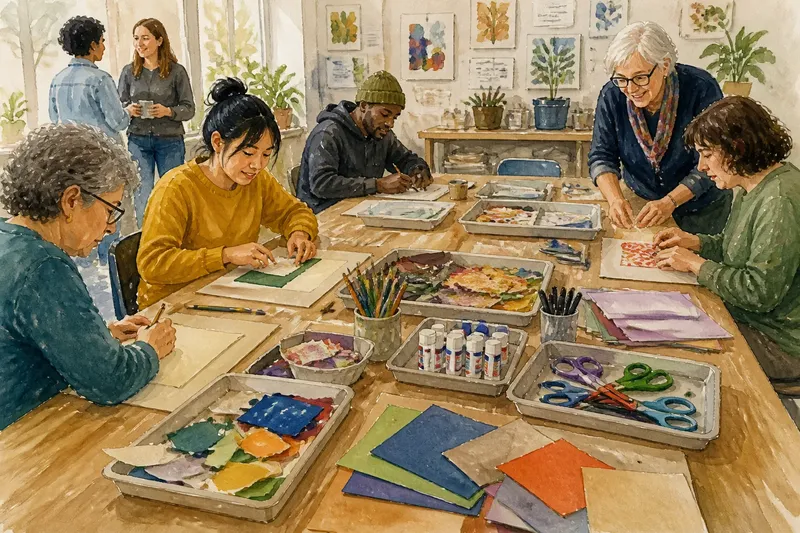
The common mistake in a community art workshop is to keep every material tucked in boxes until someone asks for it. That can make the table look orderly, but it also makes beginning feel like a request: a participant must know what to ask for, interrupt the facilitator, and risk choosing the “wrong” thing. A shared table of visible, reachable materials removes some of that friction before anyone has made a mark.
The point is not to cover every surface with supplies. A modest selection can offer enough possibility to start, while leaving room for people to discover what they want as they work. The arrangement is part of the invitation: it says that participants may look, choose, combine, and return materials without needing to prove they already know the process.
Visibility makes the first choice easier
At the start of a session, people may arrive with different levels of confidence and different ideas about what counts as art. A closed box of collage scraps offers no clue about what is inside. A shallow tray of colored paper, fabric offcuts, and blunt-ended scissors gives a newcomer something specific to notice and consider.
That visible choice can help a group begin at its own pace. One person may reach for charcoal; another may watch for a while, then pick up a scrap of blue card. Neither needs to announce a plan. Materials in reach let attention turn into a small action without a long explanation.
Reach matters literally, too. Place frequently used items where seated participants can access them, and avoid making one person the gatekeeper of every tool. If a participant needs an adaptation, such as larger-handled scissors or a clear space for a mobility aid, ask what would help rather than assuming. The arrangement should make participation easier, not turn access into a performance.
A modest selection leaves room to experiment
Too many options can blur into visual noise. When a table holds every paint, tool, surface, and embellishment available, choosing may feel like a task of sorting the whole workshop before making anything. A focused assortment gives people a few inviting starting points without dictating a final result.
For a session built around making small paper compositions, a facilitator might set out recycled card, a limited palette of colored paper, glue sticks, pencils, and a tray of found paper shapes. These materials can be combined in many ways, but the table still reads clearly. More specialized supplies can remain nearby and appear when a participant has a reason to use them.
Think of the table like a bowl of fruit on a counter: what is visible is easier to choose than what is buried in a cupboard. The analogy has limits—art materials need sensible handling and a place to return—but it captures the value of making an invitation legible. A handful of clear options often does more than a crowded display.
A hypothetical workshop changes as the table opens
Imagine a facilitator preparing a drop-in session at a neighborhood arts room. The plan is to make small paper compositions, but the group includes people who have never met and no one has to follow a model. At first, the facilitator keeps the supplies in a tote and explains the activity in detail. Participants listen, glance at the empty work surface, and wait for the next instruction.
The facilitator then places a few trays within reach: paper in several colors, pencils, glue sticks, and reusable scraps collected from earlier sessions. They leave the center of the table open and show where finished work and unused scraps can go. Rather than ask everyone to begin the same way, the facilitator invites each person to choose one item and see what it suggests.
One participant selects a narrow strip of green paper and lays it across a piece of cream card. Another starts drawing around a scrap of patterned wrapping paper. A third watches, then asks whether a larger sheet is available. The facilitator responds by bringing out a small stack of plain paper, not a whole supply cabinet. The observable result is a room moving from waiting to making, with participants shaping distinct starting points rather than copying one prescribed sample.
This invented situation does not mean every group will respond in the same way. It illustrates a useful design choice: make a first move easy, keep additional options available, and let participants’ emerging questions guide what comes next. The table supports the session without having to direct it.
How should a shared workshop table work?
What materials belong within reach?
Put the tools most likely to be used in the opening activity within easy access, such as paper, pencils, glue sticks, and a small selection of collage pieces. Keep optional or specialized supplies nearby so they can be offered when someone wants them.
How many choices should a facilitator set out?
Choose a small assortment that supports more than one approach, then notice whether participants can understand what is available at a glance. If the table looks difficult to scan, remove or group items rather than adding more.
How can materials be shared without constant supervision?
Use trays or shallow containers to show where supplies belong, and make the return place easy to recognize. A short invitation to take what is useful and return what remains can establish the rhythm without turning every choice into a permission request.
What if a participant does not know where to begin?
Offer a low-pressure prompt tied to an available material, such as choosing one color or arranging two scraps before gluing anything down. The participant can change direction later; the prompt is a doorway, not a rule.
Reset the table around what people actually use
After a session, notice which materials drew interest, which stayed untouched, and where people hesitated. This is not a scorecard for the group. It is practical information for arranging the next invitation: perhaps the scissors were hard to find, perhaps the scraps were too small to handle comfortably, or perhaps pencils helped participants settle before they chose a more unfamiliar material.
Store the remaining supplies so they can be brought back into view without making the next session depend on a large kit. Reusable offcuts, donated paper, and a few dependable tools can sustain many different prompts when they are sorted and accessible. For materials that have special handling requirements, follow the product label or manufacturer instructions.
A shared table is not simply a convenient place to put supplies. It is a quiet part of how a workshop welcomes people: materials are visible, choices feel manageable, and beginning does not require a confident speech. In a community art workshop, that small shift can give participants a little more freedom to discover what they want to make.