A First Visit to a Local Exhibition, Planned Around Your Own Pace
Plan a first visit to a local exhibition at your own pace: choose a starting area, make room for a pause, and decide what deserves another look.
The common mistake on a first visit to a local exhibition is treating the whole display as a route to finish. That turns curiosity into a task: you hurry past pieces that catch your eye, then leave unsure what you actually remember. A gentler plan starts with one area, gives you permission to pause, and leaves the choice to revisit until you know what has stayed with you.
Choose a pace before choosing a route
An exhibition may fill a single room or spread across several spaces, but the same question helps in either case: what kind of attention feels comfortable today? You might want to browse freely, settle in with a few works, or keep the visit brief and leave with one vivid impression. None of those approaches is a lesser version of seeing the exhibition.
Think of a visit like borrowing a book from a shelf: you can open it where it interests you, linger over a page, and return without having read every line. The display is not an assignment. Your attention is a good reason to choose what comes next.
Three approaches can make that choice clearer:
- Open browsing: Begin where you feel drawn and move on when your attention shifts. This suits visitors who enjoy discovery and do not want a planned sequence.
- One-area settling: Choose a single room, wall, table, or cluster and spend most of the visit there. This suits anyone who prefers a contained experience or wants time to notice details.
- Pause-and-return: Browse a little, step aside or take a break, then choose one work or area to revisit. This suits visitors whose interest becomes clearer after they have had time to take things in.
These approaches are options, not rules. You can begin with one and shift to another as the visit unfolds.
Start with one area that gives you a foothold
At the entrance, take a moment to notice where the exhibition begins and what is immediately available to see. A cluster of objects, a large image, a display case, or a work visible from the doorway can give you a natural first stop. You do not need to know why it appeals before you approach it.
Pick an area small enough to hold in mind. That might be one wall, a row of prints, a group of related objects, or a corner with a bench. If the first choice feels uninteresting, change it. The purpose is not to commit yourself to the “right” starting point; it is to give your attention somewhere concrete to land.
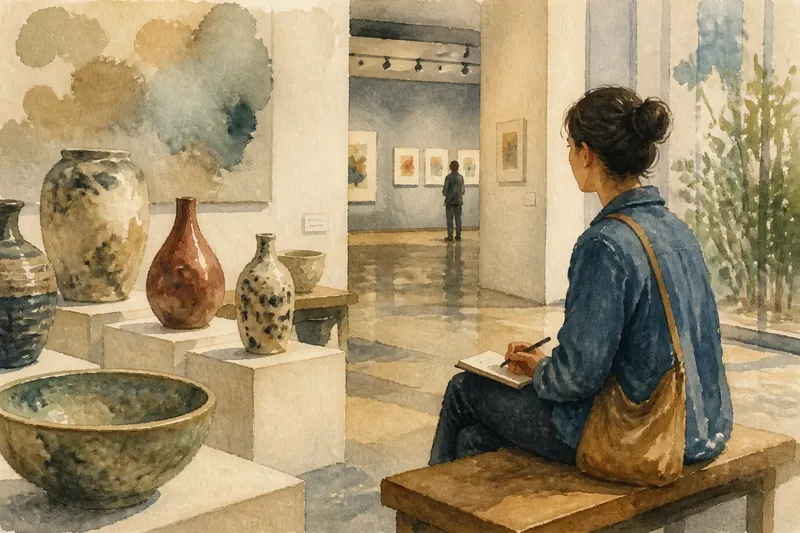
Say you enter a neighborhood exhibition with several rooms and notice a group of handmade vessels near the doorway. You decide to look at that cluster first, then sit on a nearby bench when you feel ready for a pause. Later, one vessel’s unusual surface comes back to mind, so you return for another look. The observable result is simple: you have a specific detail to remember, without having to cover every room.
Some visitors find a short caption useful before looking closely; others prefer to look first and read afterward. Try whichever order feels less like homework. A label can offer material, maker, or context, but you can still spend time with a work without absorbing every line.
Use a pause to notice what your attention is doing
A pause does not need to be a formal break. You might sit, stand back from a busy display, look out a window, or simply let the room become quiet for a moment. If a venue has a seating area, it can be useful; if not, a pause can still mean slowing down rather than moving straight to the next piece.
Notice what remains in your mind during that pause. Perhaps a color, a shape, a surprising material, a caption, or a question has followed you away from the work. That small trace can help you decide whether to return, continue elsewhere, or call the visit complete.
A pause can also reveal that you are tired, distracted, or ready to leave. That is information, not a failure of attention. A short visit can still hold a genuine encounter with a piece of local culture, especially when you leave without turning the remaining rooms into a debt.
Decide what to revisit by what stays with you
When you have seen enough to form an impression, ask yourself what you would choose to look at again if you had time for just one return. Do not select the work you think you are supposed to admire. Choose the one that has kept a question, image, or feeling active in your mind.
If nothing stands out yet, revisit the area where you felt most at ease. Familiarity can make it easier to notice a detail that was obscured by the first impression. Or simply leave without a return visit. The choice is meaningful even when it is to stop.
You can keep a small memory without turning the exhibition into an exercise. Jot down a word in your phone, remember the material or color, or tell someone afterward what caught your eye. If photography is permitted, follow the venue’s posted guidance; a note can work just as well when pictures are not appropriate.
Which pace fits your first visit?
Is it better to see every room?
Not necessarily; a first visit can be satisfying without covering the whole display. If you feel curious about the remaining rooms, continue, but let interest rather than completion set the pace.
What if I do not know where to begin?
Start with the nearest area that feels approachable, such as one visible work or a small cluster. Give it a few moments, then stay or move on according to your attention.
Can I leave and return to an exhibition later?
That depends on the venue’s entry arrangements, so check its information if you are considering leaving the building. If you mean returning to a work during the same visit, you can simply make a mental note and come back when you are ready.
How long should a first visit last?
There is no required duration: your energy, interest, and the exhibition itself all shape a comfortable visit. Decide based on whether you still want to look, rather than on how much time you think a visitor is meant to spend.
Let the visit belong to you
A useful plan for a first visit to a local exhibition is deliberately modest: choose one area, allow a pause, and see what calls you back. Open browsing works when discovery feels inviting; settling in suits a focused mood; pause-and-return gives an impression room to take shape. You can change approaches at any point.
Before you leave, name one thing you noticed, even if it is only a texture or a question you cannot answer yet. That small act makes the visit easier to carry into the rest of your day, and it gives a future visit somewhere personal to begin.